Guides
Instagram Follower Monitoring Apps for Business and Creator Accounts
Discover the best Instagram follower monitoring apps for businesses and creators. See how Unfollowers Track helps grow your audience.
Jul 17, 2026
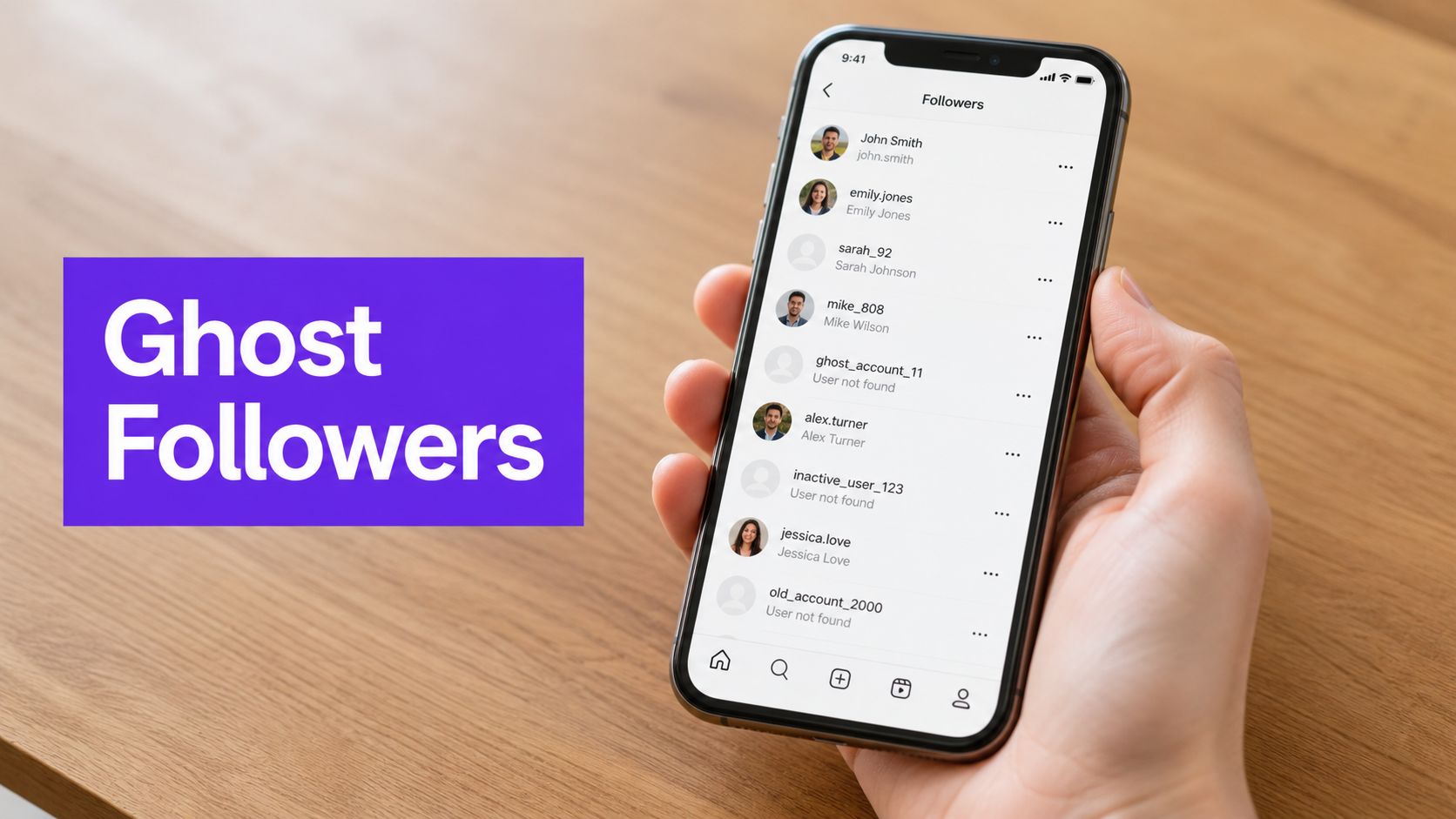
Learn what Instagram ghost followers are, how they affect engagement, ways to spot them, and smart cleanup strategies that keep your account healthy in 2026.
The popular advice is simple: find your Instagram ghost followers, remove them, and watch engagement rise. That advice confuses a cleaner denominator with stronger audience behavior. Removing followers can change a reported rate, but it doesn't prove that more people saw, liked, saved, or bought from your content.
A creator can have a large audience and still see weak visible interaction. The useful question isn't only, “How many followers are ghosts?” It's, “What can I verify, what am I estimating, and which metric should guide my next decision?”
In a hypothetical example, a creator has a Reel that attracts 800 likes but receives few direct responses, while an older post with 300 likes continues to generate direct messages. The mismatch can feel mysterious. A follower total may look healthy, yet the audience that visibly responds to new content may be much smaller.
A practical definition helps. A ghost follower is an account that follows you but shows little or no visible engagement over a stated observation period. That usually means no observable likes, comments, shares, or other interactions during the window you review, as described in this definition of a ghost follower.
That label is informal, and it doesn't prove what happened outside the data you can see. A person may watch your content without liking it, read a post without commenting, or interact through signals you can't inspect. A scan-based tool also can't automatically know whether someone viewed a Story without a visible trace or saw a post in a feed without responding.
A ghost follower isn't automatically a bot, a fake account, or a purchased follower. A real person can become inactive, change interests, stop posting, or merely consume content. An account that unfollowed you is not a ghost follower, because it no longer follows you.
Likewise, a mass-created account may look suspicious, but suspicious appearance and visible inactivity are different observations. A complete profile that once engaged and then stops interacting calls for a different interpretation than an empty profile created to inflate numbers.
Use a rolling observation window rather than judging one post. One weak publication may reflect timing, format, topic, distribution, or ordinary variation. Repeated lack of visible interaction across a stated period is more informative, but it still remains evidence of non-observed activity, not proof that the person never sees your content.
Working rule: Call an account a possible ghost follower only when it still follows you and your available evidence shows little or no visible interaction during a defined window.
That definition keeps the analysis honest. It also prevents a common mistake, treating every quiet follower as fraudulent. The rest of the process should separate relationship changes, visible behavior, profile signals, and assumptions rather than collapsing them into one score.
Engagement rate is a ratio. A commonly used calculation divides interactions by followers and multiplies the result by 100, as explained in this Instagram engagement measurement guide. Ghost followers affect the denominator even when they contribute nothing to the numerator.
Consider a hypothetical account with 10,000 followers, 300 likes, and 20 comments on a post. The likes-plus-comments-to-followers ratio is 320 / 10,000 × 100 = 3.2%. If the account removes 2,000 followers and the same post still has 320 interactions, the ratio becomes 320 / 8,000 × 100 = 4%.
| Hypothetical scenario | Actual follower count | Likes + comments | Likes-plus-comments-to-followers ratio |
|---|---|---|---|
| Before removal | 10,000 | 320 | 3.2% |
| After removing 2,000 followers | 8,000 | 320 | 4% |
Nothing about the post's interactions changed. Removing followers changed the denominator, not the number of likes or comments. Excluding selected accounts from a spreadsheet without removing them would instead produce a custom subset ratio, not the account's follower-based rate or a verified “true engagement rate.”
An account can gain followers through a viral post, a giveaway, a collaboration, or an unrelated topic. If many new followers never interact with later content, the follower count rises while visible interactions stay level. The reported engagement rate then falls even if the content still performs similarly among people who pay attention.
The reverse also happens after a removal. If the account keeps the same interactions but has fewer followers in the denominator, the percentage looks healthier. That result is mathematically valid, but it doesn't show that Instagram distributed the content more widely or that the audience became more interested.
Use follower-based engagement as a labeled comparison, not as a complete health score. Pair it with reach, saves, comments, profile visits, and other account-level signals that tell you whether people encountered and acted on the content.
People often mix three different questions: Does the account look suspicious? Does it visibly engage? And does it still follow me? Those questions overlap, but none answers the others automatically.
A low like count on one post isn't evidence of a ghost-follower problem. The post may have reached a different audience, the topic may have been less relevant, or the format may have changed. A private account can also look inactive from the outside even when its owner reads posts or watches Stories.
Some recurring observations can justify a closer review:
The phrase “inactive equals fake” creates the biggest error. Real users abandon platforms, change routines, or consume without interacting. A bot farm is another possibility, but you need stronger evidence before assigning that cause.
A public scan generally sees profile details, follower relationships, and publicly visible engagement patterns. It doesn't expose the private reasons behind inactivity. It also can't reliably distinguish a silent viewer from a person who never sees your content.
Treat a tool's output as a screening signal. A useful report should help you decide which accounts or patterns deserve manual review, not encourage automatic removal based on a single label.
Two approaches are useful, but they answer different questions. Instagram Insights shows how your content performed in aggregate. A third-party scanner estimates which visible accounts look suspicious or inactive from public data.
Start with Insights. Review recent posts, compare reach with likes and comments, and note the relationship between your total followers and the accounts reached. A wide gap can tell you that the follower total isn't a good proxy for current exposure. It can't identify individual ghost followers, and it can't tell you whether a person viewed a post.
Third-party tools differ in what they measure. A follower-list comparison documents relationship changes; it does not validate individual inactivity or fraud. Before relying on an audience-quality estimate, check the provider’s actual data sources, methodology, observation window and limitations. Do not assume every analytics or follower tracker offers the same classification features.
| Dimension | Manual Insights Review | Scan-Based Tracker Tool |
|---|---|---|
| Main evidence | Reach and aggregate interactions | Public profiles, relationships, and visible patterns |
| Identifies individual accounts | Generally no | May flag accounts for review |
| Shows silent viewing | No | No |
| Detects relationship changes | Limited to account-level changes | Possible through repeated public scans |
| Main limitation | Doesn't explain follower quality | Estimates rather than verifies inactivity or fraud |
| Best use | Assess content distribution and audience response | Find patterns worth checking manually |
A scan-based service should publish how it reaches its conclusions. Look for methodology details, separate signals, timestamps, and per-account confidence rather than one opaque “quality” number.
Unfollowers Track, for example, uses public username-based scans to compare follower relationships over time, identify changes such as unfollows, and show publicly visible engagement patterns without requiring an Instagram login. Its scan can document relationship changes, but it can't prove that a follower never reads your content or classify every quiet account as fake. More context on the limits of this category appears in whether unfollow apps are accurate.
A manual review should produce a record you can question later, not a purge list built on assumptions. Choose and record an observation window, for example 30 days, and a baseline for available post reach, likes, saves, comments and total followers. Thirty days is an illustrative review period, not a validated inactivity threshold or a product detection setting.
Review a manageable sample of followers and record how you selected it. The sample is for manual review, not a basis for estimating the entire audience’s ghost-follower rate. Capture only the evidence you can see:
Keep a spreadsheet with the date, username, observed signal, and review status. A time-stamped log helps you distinguish a one-time absence from a repeated pattern. It also prevents memory from turning a tentative observation into a confident claim.
Do not remove a follower solely because you have not observed likes or comments. Silent viewing and incomplete data remain possible. If you independently decide that a follower should no longer have access to your account, use Instagram’s own available account controls; do not treat bulk removal as a proven growth tactic.
The safest choice may be to leave uncertain accounts alone. You don't know whether a person reads without engaging, whether your available data is incomplete, or whether the account will become active again.
For workflow ideas that avoid handing over an Instagram password, see these features to look for in an Instagram unfollow tracker. The same principle applies to audience review: use evidence that can be checked, retain a history, and avoid automation that takes irreversible action without confirmation.
Removal changes the follower count, but it does not create new interactions. In a hypothetical example, an account has 10,000 followers and receives 300 likes per post. The follower-based rate is 3%. If the account removes 2,000 followers and still receives 300 likes, the same calculation becomes 3.75%.
| Hypothetical scenario | Followers | Likes per post | Likes-to-followers ratio |
|---|---|---|---|
| Before removal | 10,000 | 300 | 3% |
| After removing 2,000 followers | 8,000 | 300 | 3.75% |
That is a mathematical effect, not evidence of improved reach, stronger interest, higher sales, or better algorithmic distribution. The content received exactly the same number of likes in both rows.
A percentage in a brand deck, creator media kit, or internal report can look more favorable after a cleanup. That signaling effect may influence how someone interprets the account, even though the underlying interactions haven't changed. The right response is to label the metric clearly and show the surrounding context.
Track reach, saves, comments, profile visits, and conversions alongside follower-based engagement. These measures still require interpretation, but they provide more direct evidence of whether people encountered the content and took a meaningful action.
Measurement rule: Treat removal as audience hygiene and reporting cleanup, not as a reach lever.
A purge can make your dashboard easier to read if the removed accounts were irrelevant or inauthentic. It can also reduce the apparent size of your audience. Neither outcome guarantees that the next post will perform better.
A ghost-follower percentage is an estimate unless someone can inspect the underlying follower list and verify each account's behavior. Instagram doesn't expose enough information for outsiders to confirm who views content, so published figures depend heavily on definitions and sampling.
There is no verified Unfollowers Track study establishing an average ghost-follower rate across 100 public profiles. A percentage from another provider cannot be treated as our measurement or a benchmark for every account. Case studies about purchased or fake followers also do not establish the proportion of real followers who quietly view content.
“Fake,” “inactive,” “suspicious” and “ghost” describe different concepts. Before quoting any estimate, check its original source, definition, sample selection, observation period and validation method. If those details are unavailable, omit the number rather than presenting it as established evidence.
For your own manual review, report only what you observed. For example, state that a specified sample had no visible interactions during a stated window; do not call that the proportion of followers who never view content or extrapolate it to the entire audience without a defensible sampling method.
A healthier account isn't the one with the smallest follower list. It's the one whose reporting reflects what the creator can observe and explain. Set a fixed review cadence, use the same observation window each time, and compare follower-based engagement with reach, saves, comments, profile visits, and conversions.
A quarterly review can show whether low-quality growth is accumulating, but follower churn shouldn't become a growth signal. A sudden drop after removals may reflect cleanup rather than audience improvement. Before changing the audience, test content format, topic, timing, and distribution so you don't blame every weak result on ghosts.
Define the metric, keep the denominator consistent, and record what changed before drawing a conclusion.
Don't use a third-party tool that asks for your Instagram password or promises an automatic purge. If you're considering a tracker, review its privacy and safety model first, including the considerations in is an Instagram unfollow tracker safe.
Unfollowers Track helps you compare available public follower and following lists without requiring an Instagram password. Comparing saved scans can reveal relationship changes; it does not classify ghost followers or show who silently views your content. Use Unfollowers Track to compare relationship changes over time, then pair those records with your own review over a clearly stated observation period before deciding whether any follower needs action.
Partner resource: Taja’s guide to growing an Instagram audience. This link is included through our content-link exchange; it is not a source for the product capabilities or measurement claims above.
About the author
We are the team that builds and runs Unfollowers Track, a scan-based Instagram tracker. Everything we publish is checked against how the product actually works: scans analyze public profile data only, changes show up by comparing one scan against the next, and we never ask for your Instagram password. Read how we test and verify claims, or contact us with questions or corrections.
Guides
Discover the best Instagram follower monitoring apps for businesses and creators. See how Unfollowers Track helps grow your audience.
Jul 17, 2026
Guides
Compare Instagram follower tracker accuracy in 2026. See when to use scan-based follower tracking, Instagram Insights, and broader analytics tools.
Jul 11, 2026