Tracker tools
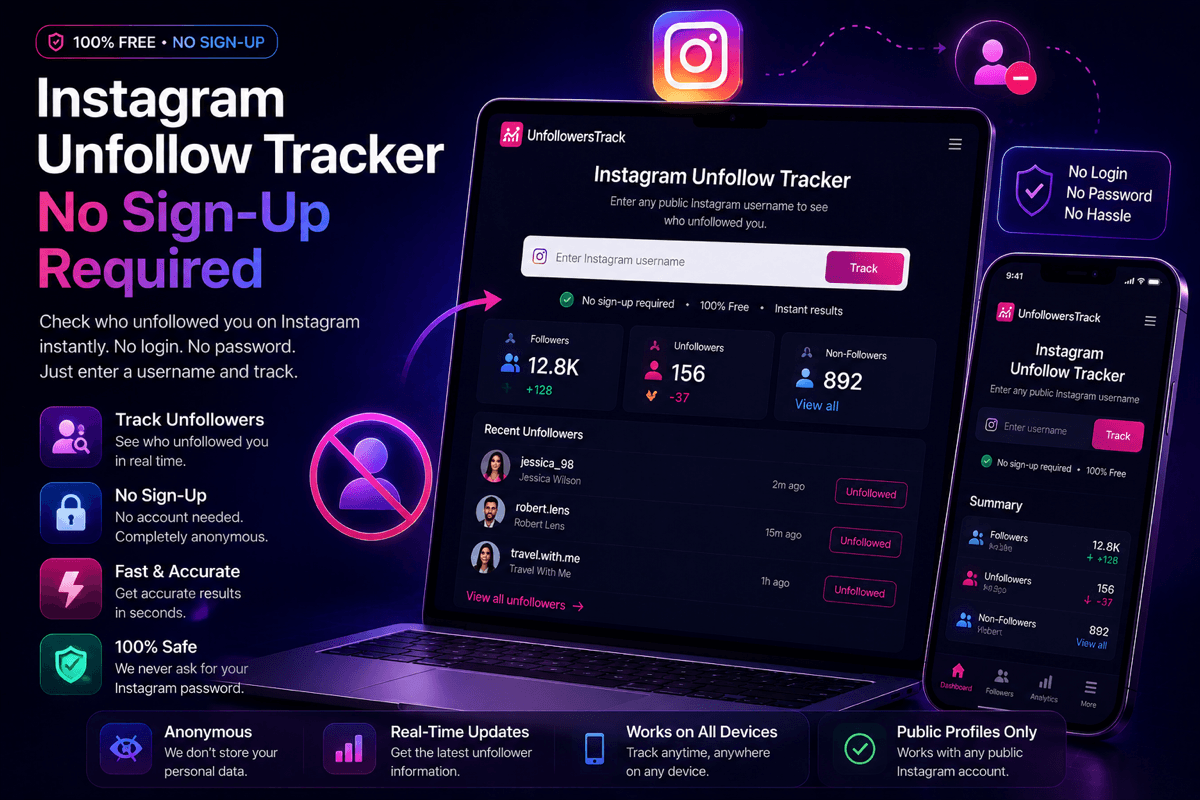
Instagram Unfollow Tracker: No Sign-Up Required
Run an Instagram unfollow tracker with no sign-up. Enter a public username and see who doesn't follow you back on your first scan, with no account and no password.
Jul 4, 2026
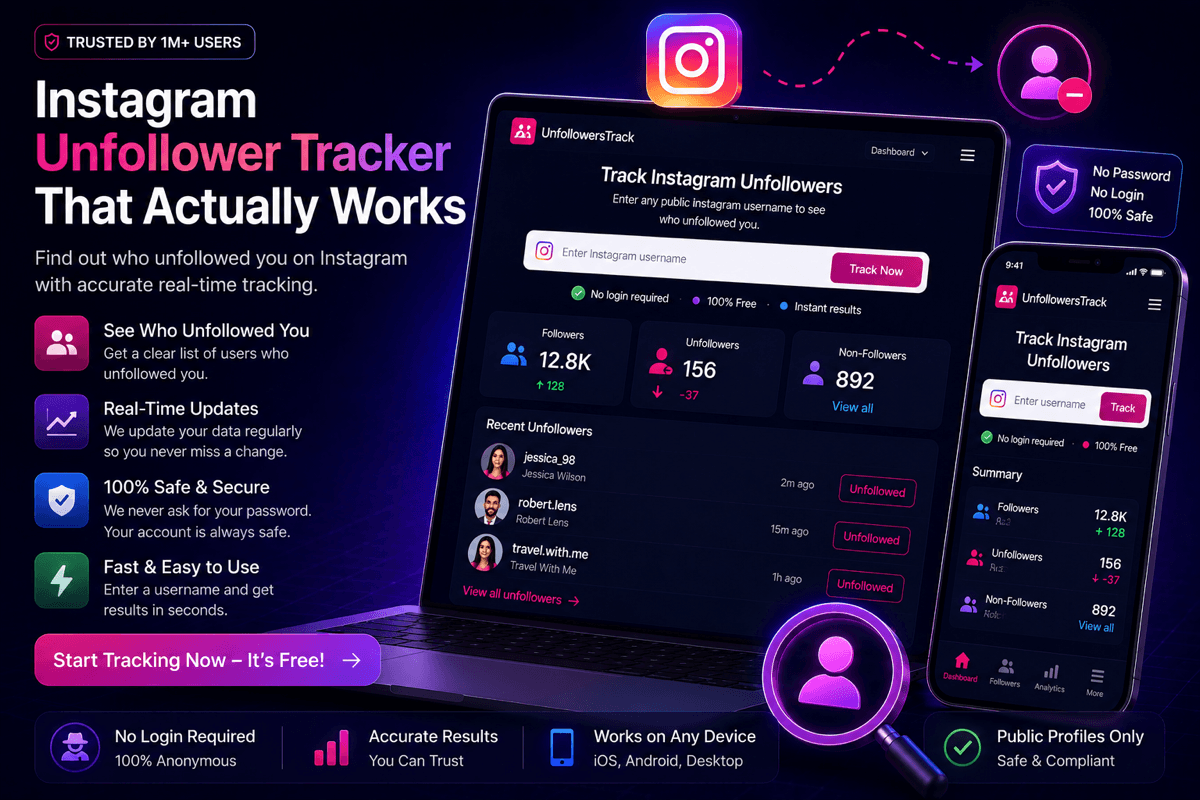
Most Instagram unfollower apps broke because they relied on your login. Here is why, how a public-data scan tracker still works in 2026, and how to verify any tracker yourself.
Key Takeaways
TLDR
A tracker that compares snapshots of your public follower list still works in 2026, because it does not depend on your Instagram login. That is why UnfollowersTrack keeps working while a lot of the old password-based apps went dark.
Most of the trackers that stopped working broke for the same reason: they logged into your account to read your followers, and Instagram tightened the rules on exactly that. Tools that read only public follower data and compare it over time never relied on that door, so closing it did not touch them.
The rest of this guide is the honest version of all of it: why the broken apps broke, a small accuracy test you can run yourself, how the scan actually works, and where it genuinely falls short.
Rewind a few years and the app stores were full of unfollower trackers. Most of them asked you to log in with your Instagram username and password, then used that session to pull your full follower list and diff it. When they worked, they worked well. The problem was the foundation.
Instagram has spent years restricting automated access to accounts. Its platform terms prohibit using your login credentials in third-party tools, and it actively detects and blocks session-based scraping and automation. As those defenses got stricter, the login-based apps started returning empty lists, stale data, or nothing at all, and a wave of them were pulled or quietly abandoned. What any specific app still claims changes over time, so check that app's own store listing for its current status and last update date.
A second group never really worked in the first place. They showed a generic "unfollowers" list that was actually just people you follow who do not follow you back, or random inactive accounts, dressed up as fresh unfollows. That is not a tracking failure, it is a design that was never measuring what it promised.
The approach that survived is the boring one. Instead of logging into your account, a scan-based tracker reads the follower information Instagram already shows publicly and saves a snapshot. Run it again later, compare the two snapshots, and the difference is your unfollows. No credentials, no session, nothing for Instagram's automation defenses to revoke.
"Works" is easy to claim and hard to prove, so here is a test you can run yourself in under an hour. It is the same method a fair review would use, and the whole point is that you do not have to take anyone's word for it.
Take a control account you own. Run a first scan to record a baseline of who currently follows it; call it snapshot one. Now make a set of known changes by hand: have a few accounts you also control unfollow it, and write down exactly which ones and when. Wait, then run a second scan. Compare the unfollowers the tracker reports against your written list. A tracker that works flags the accounts you actually removed, and does not invent ones you did not.
We describe this as a method rather than quoting a single accuracy percentage, because results depend on account size, the timing between scans, and how fresh Instagram's public data is at the moment of each scan. Anyone quoting one guaranteed accuracy number for every account is guessing. For the wider question of how reliable these tools are in general, we go deeper in how accurate unfollow apps really are.
The mechanism is deliberately simple, which is most of the reason it keeps working.
Enter username
Share your public Instagram handle.
We analyze
We compare followers and following lists.
You get results
See who unfollowed you and who doesn't follow back.
You enter a public Instagram username. No password, no logging into your account. UnfollowersTrack reads the public follower data for that profile and stores a snapshot of it. That first scan is your baseline. The next time you scan, it compares the new follower list against the saved one and shows you what changed: who left, who is new, and who never followed back.
Because it works from public data over time rather than a live feed into your account, it produces estimates of what changed between two points, not an alarm that pings the instant someone taps unfollow. There is no real-time monitoring and no need for one. You scan, it compares, you see the difference. In the plainest terms it is an Instagram unfollow tracker that reads public data and diffs it, and the login step that broke the old apps simply is not part of the flow. You can start a free scan without handing over a password.
No password also means there is nothing to leak. If you want to think through what to check before trusting any of these tools with anything, we cover whether a tracker is safe to use separately.
A tracker that actually works has to be honest about what it does not do. Here is the real list.
History starts when tracking starts. The very first scan is a blank baseline. It can only record who follows you right now, not who left last week. Your first useful result comes on the second scan, when there is finally something to compare against. Any tool that claims to show unfollows from before you started is claiming something no snapshot-based method can do.
Detection happens at scan time, not at the instant of the unfollow. Because the tool compares snapshots, an unfollow shows up the next time you scan, not the second it happens. That is the trade-off for not living inside your account, and it is the honest version of what "tracking" means here.
There is an account-size ceiling. UnfollowersTrack supports accounts up to 20,000 followers. Above that, the public follower data gets too large to snapshot reliably, so very large accounts are outside what we can cover honestly.
It works on public data only. If a profile is private and you do not have access, that follower data is not available to read, and no legitimate tool can conjure it. UnfollowersTrack is also not affiliated with Instagram or Meta; it compares public follower information over time and reports estimates of what changed.
You can hold any tool to the same standard before you trust it. Four quick checks:
One, does it ask for your Instagram password? If yes, close the tab. That requirement is the exact dependency that broke the old apps, and it is a security risk on top of it. Two, is it upfront that history starts at your first scan? Honesty about that is a green flag. Three, does it explain its method, public-data comparison rather than vague "advanced technology"? Four, can you verify it? Run the small control-account test from above and watch whether its results match reality.
That last step is the fair way to settle arguments between tools. Run the same test against the big names, FollowMeter and Dolphin Radar included, and compare what each one detects against your recorded ground truth. If you would rather have the details laid out for you, our head-to-head Instagram unfollow tracker comparison breaks down accuracy, price, and safety tool by tool.
The tracker that works in 2026 is not the flashiest one. It is the one whose method survives Instagram's restrictions and whose claims survive your own test. If you want to see your own numbers, Start tracking free, no Instagram password required, and let the second scan do the talking.
Most older apps logged into your account with your Instagram password to read your followers, and Instagram has restricted that kind of third-party access. When those defenses tightened, the login-based apps started returning empty or stale lists. Scan-based tools that read only public follower data were not built on that dependency, so they keep working.
Yes, the ones that compare public follower snapshots over time instead of logging into your account. The way to be sure is to run a small control-account test: manually unfollow a few accounts you control, rescan, and confirm the tracker flags exactly those. Run that test on any tool before you trust it.
Run a mini-test. On an account you control, note a known unfollow, rescan, and check whether the tracker flags exactly that account and does not invent ones you did not remove. Matching your own recorded ground truth is the only honest proof of accuracy.
No. Snapshot-based tracking can only compare from your first scan onward, so history starts when tracking starts. Any app claiming to reveal who unfollowed you months ago is a red flag, because no snapshot-based method can do that.
No, and that requirement is itself a warning sign. UnfollowersTrack reads public follower data and needs no login to start a scan. If a tool asks for your Instagram credentials, treat it as unsafe and close the tab.
About the author
We are the team that builds and runs Unfollowers Track, a scan-based Instagram tracker. Everything we publish is checked against how the product actually works: scans analyze public profile data only, changes show up by comparing one scan against the next, and we never ask for your Instagram password. Unfollowers Track is owned and operated by NaviStack LLC. Learn more about Unfollowers Track, read how we test and verify claims, or contact us with questions or corrections.
Unfollowers Track
Start with a free preview of who doesn't follow you back. Ongoing tracking then compares each completed scan with the last one, so you can see who unfollowed you in between.
Tracker tools
Run an Instagram unfollow tracker with no sign-up. Enter a public username and see who doesn't follow you back on your first scan, with no account and no password.
Jul 4, 2026
Tracker tools
Discover the best no-login Instagram unfollow tracker websites in 2026. Use Unfollowers Track to monitor unfollows without sharing login details.
Jun 18, 2026
Tracker tools
Compare five Instagram unfollow trackers by platform, login requirement, public-profile support, tracking method, and cost to start.
Jun 8, 2026
Tracker tools
Discover the top features to look for in an Instagram unfollow tracker. Learn how Unfollowers Track helps you monitor followers and analyze engagement.
Apr 9, 2026